

Best Programs For League of Legends


Last updated: May 2026. Refreshed for Season 16, current Vanguard kernel-level anti-cheat status, and the changes in the LoL companion-app market over the past two years.
Now that we are deep into 2026, League of Legends has gone through one of its largest structural shifts in years — Vanguard kernel anti-cheat is fully live, the ranked system has been overhauled twice (the 2024 split-system and the 2026 Apex reset), and the third-party companion-app ecosystem has reshuffled significantly. In this article we look at the top 8 programs that have stayed relevant, what has changed for each, and which newer tools have emerged since the original ranking was published. Picks are based on current user reviews, performance under Vanguard, and how each app is keeping up with Season 16.
UPDATED IN 2026 FOR SEASON 16. All apps below have been re-tested against current patches and confirmed working with Vanguard. Where a tool’s relevance has shifted, that’s noted in its section.
Mobalytics:
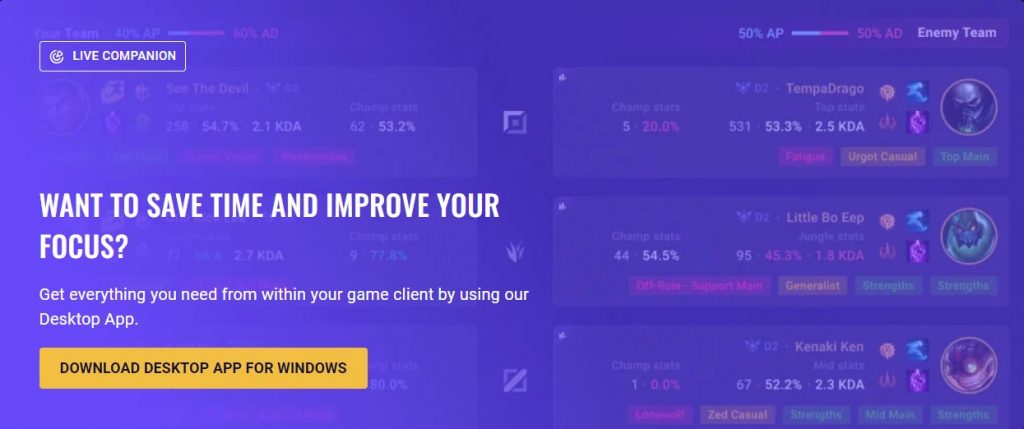
Mobalytics, the long-running champion of third-party apps, runs through Overwolf and consistently provides strong metrics for measuring player performance. It still includes the GPI (Gameplay Performance Index) score and live tier-list challenges, with reasonable build/runes recommendations and adapt-on-the-fly champion guides.
2026 update: Mobalytics confirmed it is fully Vanguard-compatible and remains one of the most complete LoL apps available. That said, the picture is more mixed than it was in 2024 — current Overwolf review average is around 3.6/5, with users citing rising ad coverage, occasional RAM spikes, and the platform feeling dated against newer entrants. Free tier still gives most of the core value; the paid tier (Mobalytics Plus) unlocks ad removal and deeper analytics. Still our pick for “best all-in-one” if you want one app to install and forget.
Porofessor:
Porofessor, used by close to 9 million users including pro teams and streamers, offers incredibly high levels of pre-game and in-game analysis with its “death by charts” approach. The data is rich — opponent rank history, recent performance trends, current win streaks, hot champions — but users have to know how to apply it. Porofessor encourages critical thinking but is intentionally light on direct calls to action, which is great if you want to learn and frustrating if you want a one-line answer.
2026 update: Porofessor is still a popular pick for serious solo-queue players and remains listed and active on Overwolf with full Vanguard compatibility. The main complaints in 2026 are around mandatory Overwolf dependency (consistent across all overlay-based apps) and intermittent loading errors during peak hours. If you don’t mind running Overwolf, Porofessor is still the deepest pre-game stats app on the market.
Zar:
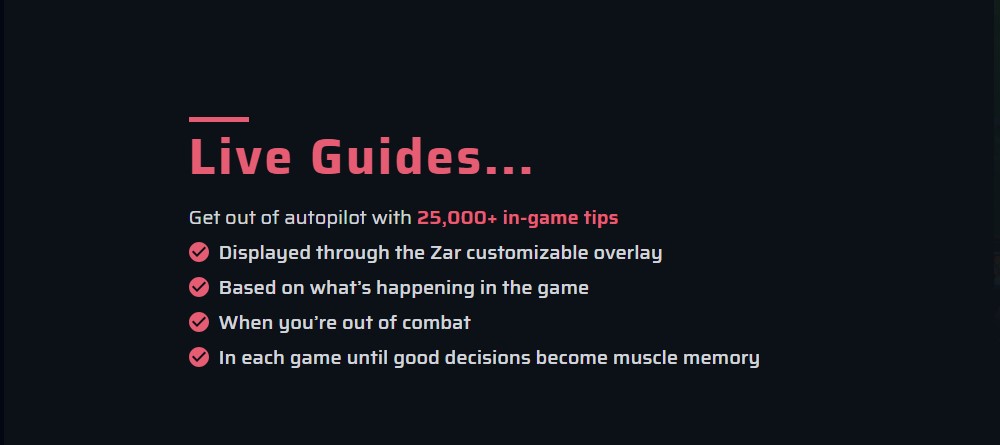
Zar stands out with its unique macro-coaching feature, providing in-game messages to nudge players on objectives, wave management, and rotations. The quality of the prompts varies game to game, but no other widely-available app does this in real time. Zar’s design intent — encourage independent decision-making rather than give answers — makes it a good fit for players who already understand fundamentals and are working on macro.
2026 update: Zar still occupies a niche slot. It hasn’t expanded its feature set significantly since 2024 and isn’t the right pick if you want stats or builds — it’s specifically a macro-prompt tool. Still useful as a complement to Mobalytics or Porofessor if you can run two overlays without performance issues.
Face Check:
Face Check earned a redemption arc since the original ranking. Its Scouting Report isn’t always accurate — opponent threat assessment is hit or miss in lower elos — but the core feature set is essential: matchup-aware build suggestions, custom build management, and integration with the official client. It does what it claims and stays out of the way.
2026 update: Face Check has continued to push small-but-steady updates. The matchup builds engine got better with each patch, and it remains lightweight compared to Mobalytics or Blitz. If you only want pre-game build recommendations and don’t need a full overlay, it’s still a solid free pick.
U.GG:
U.GG is a solid app with a minor issue where overlays must be on-screen at all times — there’s no toggleable hide-and-show like some competitors. Despite the drawback, the data is consistently strong and the website (u.gg) remains one of the cleanest free statistics resources for LoL builds, runes, and tier lists.
2026 update: U.GG continues to be a reliable choice, particularly for players who do most of their research on the website rather than via overlay. The free web version covers what most players actually need (tier list, current builds, counter recommendations) without installing anything — a rare strength in the current Overwolf-dominated market.
Blitz:
Blitz, the original beginner-friendly app, offers a wealth of features but has long been hindered by an abundance of ads and a significant paywall on advanced features. While it provides everything a beginner needs — auto-import builds, runes, post-game stats — the complaints about ads and limited free features have followed it for years.
2026 update: Blitz expanded into more games (Valorant, TFT, Wild Rift) which paradoxically made the LoL experience feel less prioritized. It is still on Overwolf and Vanguard-compatible, but for LoL specifically Mobalytics or U.GG are usually the better free alternative in 2026 unless you specifically value the multi-game dashboard.
Pro Comps:
Pro Comps is an app designed for five-stacking Clash tournaments. While it’s great for learning about team-comp synergies, it lacks in-depth during-game and post-game breakdowns. Unique in its lane but not essential for most solo-queue games — it earns its spot for any player serious about Clash or premade flex queue.
2026 update: Pro Comps remains the niche pick for organized 5-stack play. With Riot continuing to invest in Clash as a stable mode in 2026, the app stays useful if your group plays Clash regularly. Solo-queue players can safely skip it.
League Tracker:
League Tracker, a small developer’s app, excels in tracking summoner-spell cooldowns. It provides notifications when an enemy spell is coming off cooldown — a real edge in mid-to-late game team fights. Limited in scope, but sharp at what it does.
2026 update: League Tracker hasn’t expanded much beyond cooldown tracking — that focus is its strength. It’s a good companion app to run alongside Mobalytics or U.GG if cooldown awareness is the specific habit you’re working on. Independent indie developers tend to have less polish, so expect slightly rougher UI, but the core feature works.
Vanguard Anti-Cheat: What Changed for Third-Party Apps
The biggest structural change since this article was first written is Riot’s Vanguard kernel-level anti-cheat, which rolled out for League of Legends in May 2024 and has been operating continuously since. Vanguard runs at the kernel level, meaning it has deeper system access than typical anti-cheats, and there was significant community concern about whether overlay apps would still work.
Two years in, the answer is clear: legitimate third-party apps available through Overwolf are fully safe to use with Vanguard installed. Per Overwolf’s official statements, apps that comply with Riot’s API terms present no risk of account bans, and there are no substantiated cases of users being banned for running listed companion apps. Riot’s own official third-party application policy distinguishes clearly between allowed companion apps and prohibited tools (auto-clickers, scripts, “smart” cast helpers, etc.) — the latter were always bannable, Vanguard just makes detection more reliable.
The practical 2026 takeaway: if an app is listed on the official Overwolf LoL store, it has been vetted and is safe. Anything you find via random YouTube tutorials or Discord links — that’s where risk lives.
Notable Newer Apps (2026 Additions)
The companion-app market hasn’t stood still. Several tools have entered the space since the original ranking, and a few are worth mentioning:
Buildzcrank — an analytics-driven build recommender that focuses specifically on in-game build optimization based on opponent matchups and live game state. It’s lighter than Mobalytics and doesn’t require Overwolf, which appeals to players frustrated by overlay-app overhead.
Riot’s official Stats Portal — Riot has continued investing in first-party tools through the official client, particularly post-game match analysis and the in-client champion mastery system. These won’t replace third-party apps but cover more of the basic stats use case than they used to.
Choosing the Right App for Your Goal
If you’re trying to decide between apps, the question isn’t “which is best” but “what am I trying to fix?”. A simple guide:
- You want one app to install and forget: Mobalytics.
- You want the deepest pre-game intel: Porofessor.
- You’re working on macro and decision-making: Zar.
- You only need build paths and don’t want an overlay: U.GG (web).
- You play Clash with a five-stack: Pro Comps.
- You want to fix specific habits like cooldown tracking: League Tracker.
One consistent caveat across all of these tools: apps surface information, but they don’t tell you which information actually matters for your rank and your specific play patterns. If you’ve plateaued — you’re using two or three apps and still not climbing — the bottleneck is usually not data access. It’s identifying which decisions you’re making wrong, which is harder to figure out alone.
That’s where personalized review beats apps. 1-on-1 coaching with a Master+ player looks at your actual replays and your actual decisions, not generic averages. We mention it here only because it solves a different problem than apps do — apps surface information, coaching tells you which information matters for you specifically.
Frequently Asked Questions
Are League of Legends third-party apps safe in 2026 with Vanguard installed?
Yes — apps available through the official Overwolf store are vetted and confirmed safe with Vanguard. The risk lives in apps you find outside official channels. Stick to the Overwolf store and you’ll be fine.
Will I get banned for using Mobalytics, Porofessor, or Blitz?
No. All three are explicitly compliant with Riot’s third-party application terms. There are no documented cases of bans for using any of these. Apps that DO get you banned are the ones that automate gameplay (auto-cast, auto-skill-shot dodging, etc.) — none of the apps in this list do that.
Do I need to install all eight of these apps?
No, and please don’t. Running multiple overlay apps simultaneously causes RAM and FPS issues even on modern systems. Pick one main companion app (Mobalytics or Porofessor for most players) and one specialist tool if you need a specific feature (Zar for macro prompts, League Tracker for cooldowns).
Which app is best for low-rank players (Iron through Gold)?
U.GG (web) or Mobalytics. At lower ranks, the bottleneck is fundamentals — wave management, basic itemization, knowing your champion’s power spikes. You don’t need the depth of Porofessor’s opponent analysis until your fundamentals are solid. Save the heavyweight tools for Platinum and above.
Which app is best for high-rank players (Diamond and above)?
Porofessor for opponent intel, plus a specialist tool for whatever you’re specifically working on. At high ranks, marginal information advantages matter, and Porofessor’s depth pays off. Combine with replay review (using the in-client tool) for the strongest practice loop.
Final words:
The League of Legends companion-app ecosystem looks different in 2026 than it did when this article was first written. Vanguard came and went without breaking the legitimate-app market, the Big Three (Mobalytics, Porofessor, Blitz) are still dominant but no longer unchallenged, and lighter tools like Buildzcrank and Riot’s own first-party stats have closed some of the gap. For most players in 2026, the practical advice hasn’t changed much: pick one main companion app, add a specialist tool if you have a specific habit you’re working on, and don’t fall into the trap of installing five overlays in the hope that information alone will rank you up.
If you’ve already optimized your tools and you’re still stuck at the same rank, the issue isn’t your apps — it’s the decisions you’re making with the information they’re giving you. That’s a different problem to solve. Personalized 1-on-1 coaching or a focused boost often produces a faster breakthrough at that point than another app install will.